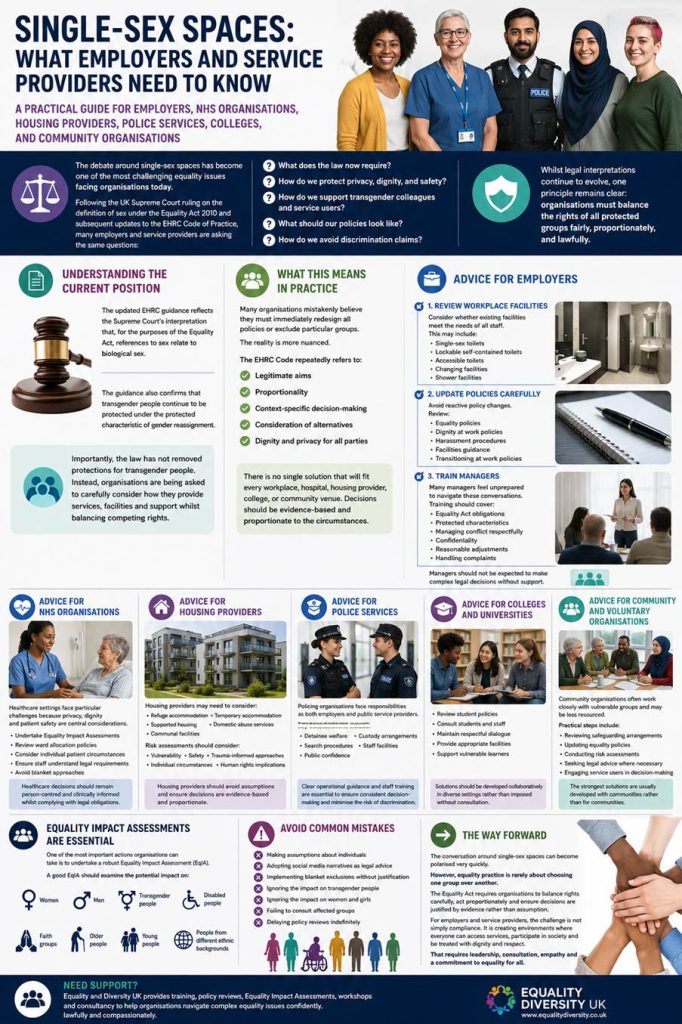
A Practical Guide for Employers, NHS Organisations, Housing Providers, Police Services, Colleges, and Community Organisations
The debate around single-sex spaces has become one of the most challenging equality issues facing organisations today.
Following the UK Supreme Court ruling on the definition of sex under the Equality Act 2010 and subsequent updates to the Equality and Human Rights Commission (EHRC) Code of Practice, many employers and service providers are asking the same questions:
- What does the law now require?
- How do we protect privacy, dignity, and safety?
- How do we support transgender colleagues and service users?
- What should our policies look like?
- How do we avoid discrimination claims?
Whilst legal interpretations continue to evolve, one principle remains clear: organisations must balance the rights of all protected groups fairly, proportionately, and lawfully.
Understanding the Current Position
The updated EHRC guidance reflects the Supreme Court’s interpretation that, for the purposes of the Equality Act, references to sex relate to biological sex. The guidance also confirms that transgender people continue to be protected under the protected characteristic of gender reassignment.
Importantly, the law has not removed protections for transgender people. Instead, organisations are being asked to carefully consider how they provide services, facilities and support whilst balancing competing rights.
What This Means in Practice
Many organisations mistakenly believe they must immediately redesign all policies or exclude particular groups.
The reality is more nuanced.
The EHRC Code repeatedly refers to:
- Legitimate aims
- Proportionality
- Context-specific decision-making
- Consideration of alternatives
- Dignity and privacy for all parties
There is no single solution that will fit every workplace, hospital, housing provider, college, or community venue. Decisions should be evidence-based and proportionate to the circumstances.
Advice for Employers
Review Workplace Facilities
Consider whether existing facilities meet the needs of all staff.
This may include:
- Single-sex toilets
- Lockable self-contained toilets
- Accessible toilets
- Changing facilities
- Shower facilities
Many organisations are finding that additional privacy measures benefit everyone, regardless of sex, gender identity, religion, disability, or cultural background.
Update Policies Carefully
Avoid reactive policy changes.
Review:
- Equality policies
- Dignity at work policies
- Harassment procedures
- Facilities guidance
- Transitioning at work policies
Policies should clearly state that all employees will be treated with dignity and respect and that discrimination, harassment or victimisation will not be tolerated.
Train Managers
Many managers feel unprepared to navigate these conversations.
Training should cover:
- Equality Act obligations
- Protected characteristics
- Managing conflict respectfully
- Confidentiality
- Reasonable adjustments
- Handling complaints
Managers should not be expected to make complex legal decisions without support.
Advice for NHS Organisations
Healthcare settings face particular challenges because privacy, dignity and patient safety are central considerations.
Organisations should:
- Undertake Equality Impact Assessments
- Review ward allocation policies
- Consider individual patient circumstances
- Ensure staff understand legal requirements
- Avoid blanket approaches
Healthcare decisions should remain person-centred and clinically informed whilst complying with legal obligations.
Advice for Housing Providers
Housing providers may need to consider:
- Refuge accommodation
- Temporary accommodation
- Supported housing
- Domestic abuse services
- Communal facilities
Risk assessments should consider:
- Vulnerability
- Safety
- Trauma-informed approaches
- Individual circumstances
- Human rights implications
Housing providers should avoid assumptions and ensure decisions are evidence-based and proportionate.
Advice for Police Services
Policing organisations face responsibilities as both employers and public service providers.
Key considerations include:
- Detainee welfare
- Custody arrangements
- Search procedures
- Staff facilities
- Public confidence
Clear operational guidance and staff training are essential to ensure consistent decision-making and minimise the risk of discrimination.
Advice for Colleges and Universities
Education providers should:
- Review student policies
- Consult students and staff
- Maintain respectful dialogue
- Provide appropriate facilities
- Support vulnerable learners
Educational settings often contain individuals from diverse backgrounds, faiths, cultures, and identities. Solutions should therefore be developed collaboratively rather than imposed without consultation.
Advice for Community and Voluntary Organisations
Community organisations often work closely with vulnerable groups and may be less resourced than larger public bodies.
Practical steps include:
- Reviewing safeguarding arrangements
- Updating equality policies
- Conducting risk assessments
- Seeking legal advice where necessary
- Engaging service users in decision-making
The strongest solutions are usually developed with communities rather than for communities.
Equality Impact Assessments Are Essential
One of the most important actions organisations can take is to undertake a robust Equality Impact Assessment (EqIA).
A good EqIA should examine the potential impact on:
- Women
- Men
- Transgender people
- Disabled people
- Faith groups
- Older people
- Young people
- People from different ethnic backgrounds
Intersectionality matters. Individuals often belong to more than one protected group, and these experiences can overlap in complex ways.
Avoid Common Mistakes
Organisations should avoid:
- Making assumptions about individuals
- Adopting social media narratives as legal advice
- Implementing blanket exclusions without justification
- Ignoring the impact on transgender people
- Ignoring the impact on women and girls
- Failing to consult affected groups
- Delaying policy reviews indefinitely
The Way Forward
The conversation around single-sex spaces can become polarised very quickly.
However, equality practice is rarely about choosing one group over another.
The Equality Act requires organisations to balance rights carefully, act proportionately and ensure decisions are justified by evidence rather than assumption. The updated EHRC Code continues to emphasise proportionality, legitimate aims and consideration of less intrusive alternatives when making decisions about single-sex provision.
For employers and service providers, the challenge is not simply compliance. It is creating environments where everyone can access services, participate in society and be treated with dignity and respect.
That requires leadership, consultation, empathy, and a commitment to equality for all.
Need support?
Equality and Diversity UK provides training, policy reviews, Equality Impact Assessments, workshops, and consultancy to help organisations navigate complex equality issues confidently, lawfully, and compassionately.