From Barriers to Brilliance: Why Neurodiversity is Everyone’s Business
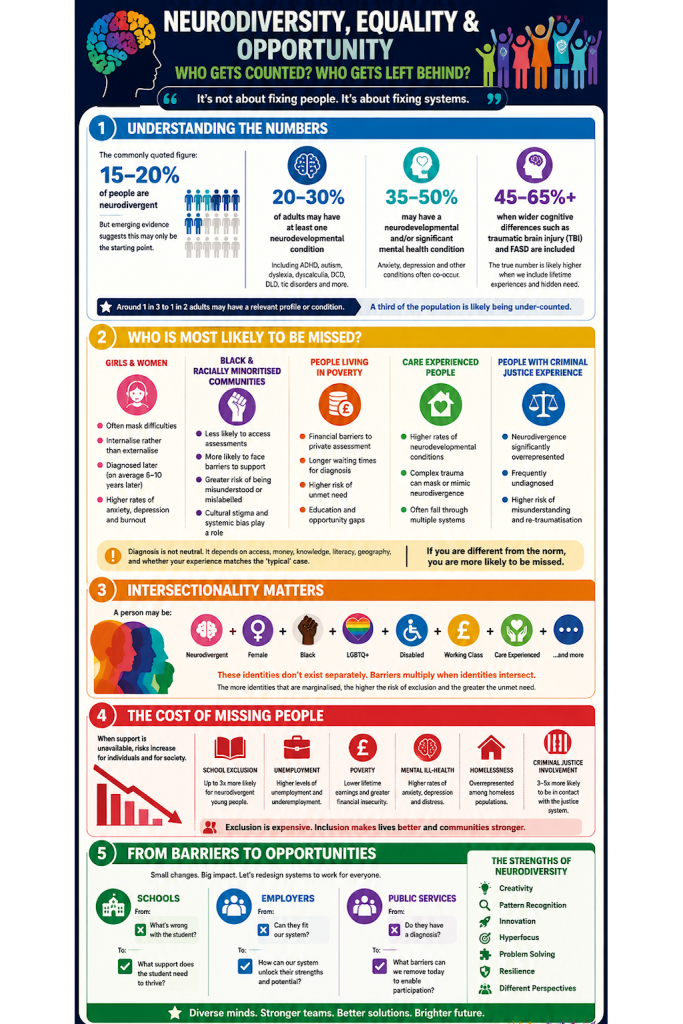
For years we have heard that around 15-20% of people are neurodivergent.
It sounds neat. Manageable. Scientific.
The problem is that human beings are rarely neat, and when it comes to neurodiversity, the numbers tell only part of the story.
Recent thinking from leading researchers suggests that when we account for overlapping conditions, hidden populations, missed diagnoses and wider neurodevelopmental differences, the figure may be much higher. Some estimates suggest that 20-30% of adults have at least one neurodevelopmental condition, while broader definitions including mental health conditions, traumatic brain injury and other cognitive differences may affect up to half the population.
The real question is not:
“How many neurodivergent people are there?”
The real question is:
“How many people are being prevented from reaching their potential because systems were never designed with them in mind?”
And when we examine this through the lens of equality, diversity and inclusion, the answer becomes impossible to ignore.
The Hidden Inequality Behind the Numbers
Diagnosis is not distributed equally.
Who gets identified often depends on:
- Gender
- Ethnicity
- Socioeconomic background
- Geography
- Access to healthcare
- Educational opportunities
- Family advocacy
Historically, diagnostic criteria for ADHD and autism were developed primarily using studies of white boys and men.
As a result, thousands of girls, women and people from racialised communities have been overlooked.
Research consistently shows that:
- Girls are more likely to mask autistic traits.
- Women are often diagnosed later in life.
- Black children are less likely to receive timely neurodevelopmental assessments.
- Children from disadvantaged backgrounds face longer waits for support.
- Adults who left education early or experienced exclusion frequently remain undiagnosed.
The result?
People are often labelled as:
- Disruptive
- Lazy
- Challenging
- Unmotivated
- Difficult
when the reality is that they simply needed understanding, adjustments and support.
Gender Matters
For decades, ADHD was viewed as a “boys’ condition.”
Yet research now shows that many girls present differently.
Girls may:
- Internalise difficulties rather than act out.
- Experience anxiety instead of hyperactivity.
- Mask social challenges.
- Work harder to hide struggles.
Many women reach adulthood before discovering why everyday tasks have felt exhausting for years.
The consequences can include:
- Lower confidence
- Higher rates of anxiety and depression
- Workplace burnout
- Financial instability
- Reduced career progression
This is not a lack of capability.
It is a failure of recognition.
Race Matters
Race and neurodiversity intersect in powerful ways.
Studies across the UK and internationally have highlighted concerns that Black children are often over-represented in behavioural sanctions while under-represented in neurodevelopmental assessment pathways.
Young people from racialised communities frequently report:
- Cultural stigma around diagnosis
- Limited access to specialist services
- Reduced trust in institutions
- Lack of culturally competent assessment
When neurodiversity and racial inequality combine, barriers multiply.
A Black autistic girl may experience obstacles that neither white autistic girls nor neurotypical Black girls experience.
This is why intersectionality matters.
What is Intersectionality?
Intersectionality recognises that people do not experience inequality through a single identity.
Someone may be:
- Neurodivergent
- Female
- Black
- Working class
- LGBTQ+
- A carer
- Living with a disability
all at the same time.
These identities do not operate separately.
They interact.
The barriers become layered.
Understanding intersectionality helps organisations move beyond “one size fits all” approaches and create genuinely inclusive environments.
The Cost of Missing People
When people are not identified or supported, the impact extends far beyond the individual.
Research links unmet neurodevelopmental needs with increased risks of:
- School exclusion
- Unemployment
- Poverty
- Mental health difficulties
- Homelessness
- Contact with the criminal justice system
This is not only a personal issue.
It is an economic issue.
It is a workforce issue.
It is a social justice issue.
The cost of exclusion is far greater than the cost of inclusion.
From Barriers to Opportunities
The good news is that neurodiversity is not a deficit model.
Many neurodivergent people bring exceptional strengths including:
- Creativity
- Innovation
- Problem-solving
- Pattern recognition
- Hyperfocus
- Entrepreneurial thinking
- Resilience
The challenge is not fixing people.
The challenge is fixing environments.
Schools
Move from:
❌ “What’s wrong with this student?”
To:
✅ “What support does this student need to thrive?”
Employers
Move from:
❌ “Can they fit our system?”
To:
✅ “How can our system unlock their strengths?”
Public Services
Move from:
❌ “Do they have a diagnosis?”
To:
✅ “What barriers are preventing participation?”
High Energy, Low Excuses
Inclusion is not about lowering standards.
It is about removing unnecessary barriers.
It is about recognising talent that would otherwise be lost.
It is about understanding that equality is not giving everyone the same thing.
Equality is ensuring everyone has a fair opportunity to succeed.
The future belongs to organisations that can harness difference, not fear it.
The most successful workplaces, colleges, communities and public services will not be those that ask:
“How many neurodivergent people do we have?”
They will ask:
“How many people are we unintentionally excluding?”
Because every missed diagnosis, every unsupported learner, every overlooked employee and every unheard voice represents lost potential.
And potential is far too valuable to waste.
The Challenge for Leaders
The evidence is clear.
The numbers are bigger than many people think.
The inequalities are deeper than many people realise.
The opportunity is greater than many organisations imagine.
The question is no longer whether neurodiversity matters.
The question is whether we are prepared to build systems that work for the full range of human talent.
The organisations that do will not simply become more inclusive.
They will become more innovative, more productive and more successful.
High energy.
High expectations.
High support.
Low excuses.
That’s how we move from barriers to opportunities.