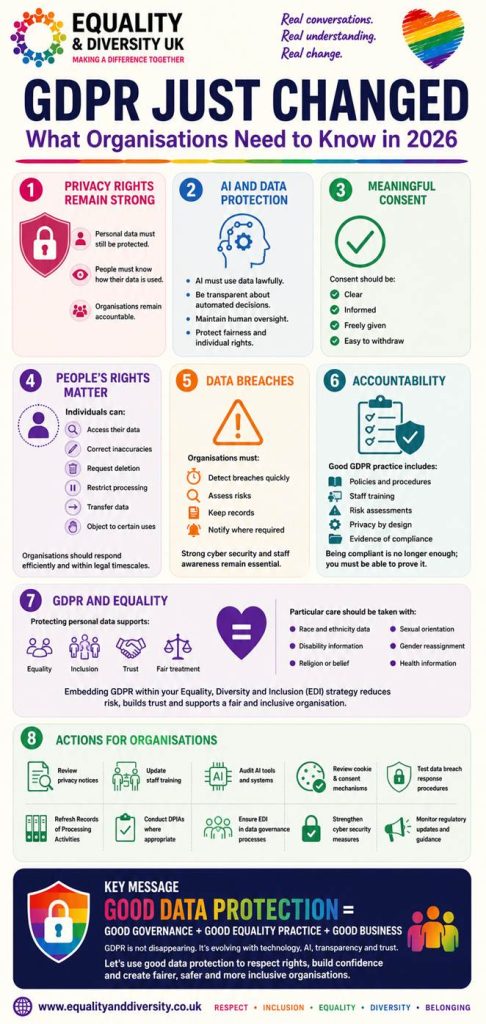
The world of data protection is evolving once again. While the core principles of the General Data Protection Regulation (GDPR) remain unchanged, regulators and policymakers across Europe are proposing reforms designed to simplify compliance, reduce administrative burdens, and address emerging technologies such as Artificial Intelligence (AI).
For employers, education providers, charities, public bodies, and businesses, the message is clear: privacy remains a fundamental right, but organisations must adapt to a changing digital landscape.
Why Is GDPR Changing?
The European Commission has proposed a package of reforms aimed at:
- Reducing unnecessary bureaucracy.
- Simplifying compliance for smaller organisations.
- Addressing consent fatigue caused by excessive cookie banners.
- Clarifying how personal data can be used in AI systems.
- Improving consistency across EU member states.
While many proposals are still under discussion, they provide a strong indication of the future direction of privacy regulation.
Key Message 1: Privacy Rights Are Here to Stay
The most important message is that GDPR’s core purpose remains unchanged:
- Protecting personal information.
- Ensuring transparency.
- Giving individuals control over their data.
- Holding organisations accountable for how data is used.
Organisations should not assume that simplification means weaker privacy protections. In many cases, the expectation of accountability remains just as strong.
Key Message 2: AI and Data Protection Are Becoming Closely Linked
One of the biggest developments is the growing relationship between GDPR and Artificial Intelligence.
Organisations using AI tools must consider:
- Lawful use of personal data.
- Transparency about automated processing.
- Human oversight.
- Individuals’ rights to challenge decisions that significantly affect them.
As AI becomes embedded in recruitment, education, customer service, and decision-making processes, organisations must ensure that innovation does not come at the expense of privacy and fairness.
Key Message 3: Consent Must Be Meaningful
Proposed reforms seek to reduce “consent fatigue” caused by endless cookie banners and repetitive requests for permission. Future requirements may include:
- Simpler consent mechanisms.
- Equal prominence for “Accept All” and “Reject All” options.
- Respecting user choices for longer periods.
- Recognition of browser-based privacy preferences.
The lesson for organisations is simple:
Consent should be clear, informed, freely given, and easy to withdraw.
Key Message 4: Data Subject Rights Remain Essential
Individuals continue to have important rights, including:
- Access to their data.
- Correction of inaccurate information.
- Erasure where appropriate.
- Restriction of processing.
- Data portability.
- Objection to certain uses of their information.
Organisations should regularly review their procedures to ensure they can respond to requests efficiently and within legal timescales.
Key Message 5: Data Breach Management Must Improve
Proposals suggest changes to breach reporting thresholds and streamlined reporting systems. However, organisations will still need robust processes to:
- Detect breaches quickly.
- Assess risk.
- Record incidents.
- Notify regulators and affected individuals when required.
Strong cyber security and staff awareness remain critical components of GDPR compliance.
Key Message 6: Accountability Is More Important Than Ever
Whether you are a school, charity, employer, local authority, or business, accountability remains central to GDPR.
This means:
- Maintaining appropriate policies.
- Training staff.
- Conducting risk assessments.
- Demonstrating compliance.
- Embedding privacy by design into projects and services.
Being compliant is no longer enough; organisations must be able to prove they are compliant.
Key Message 7: Equality, Inclusion and Data Protection Go Hand in Hand
Data protection is also an equality issue.
Many organisations process sensitive information relating to:
- Race and ethnicity.
- Disability.
- Religion or belief.
- Sexual orientation.
- Gender reassignment.
- Health information.
Protecting this data helps build trust, supports inclusion, and reduces the risk of discrimination. Organisations should ensure that GDPR compliance is embedded within their Equality, Diversity and Inclusion (EDI) strategy.
Practical Actions for Organisations
To prepare for future GDPR developments, organisations should:
✓ Review privacy notices.
✓ Update data protection training.
✓ Audit AI tools and automated systems.
✓ Review cookie and consent mechanisms.
✓ Test data breach response procedures.
✓ Refresh Records of Processing Activities.
✓ Conduct Data Protection Impact Assessments where appropriate.
✓ Ensure EDI considerations are included in data governance processes.
✓ Strengthen cyber security measures.
✓ Monitor regulatory updates and guidance.
Final Thought
GDPR is not disappearing. If anything, the future of data protection is becoming more closely connected to technology, AI, transparency, and trust.
The organisations that will succeed are those that move beyond seeing GDPR as a compliance exercise and instead view it as a commitment to respecting people’s rights, protecting personal information, and building confidence with staff, customers, learners, and communities.
Good data protection is good governance, good equality practice, and good business.