
The most powerful line in this entire conversation was not about productivity, diagnosis, or performance.
It was this:
“Someone took the time to see the real me, not my symptoms.”
That is the difference between a workplace where neurodivergent people survive and one where they thrive.
Across the comments I read in the LinkedIn article, one message appears repeatedly:
People with AuDHD are not failing because they lack talent, intelligence, creativity, commitment, or potential.
They are burning out trying to function in systems that were never designed with them in mind.
For employers, educators, managers, HR professionals, and leaders, this is not simply an awareness issue anymore.
It is a culture issue.
A leadership issue.
An inclusion issue.
And increasingly, a legal and moral responsibility.
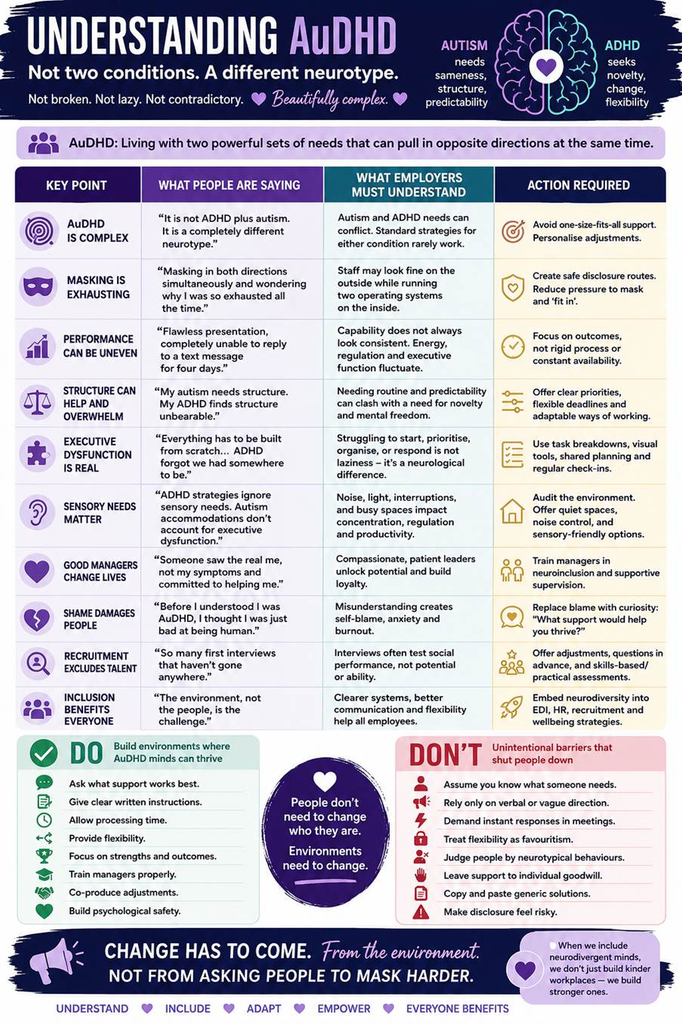
Understanding AuDHD
AuDHD is the co-occurrence of autism and ADHD.
But as many people in the discussion explained:
it is not simply “autism + ADHD.”
It is a distinct neurotype with competing needs that often create constant internal tension.
People described experiences such as:
- Needing structure while simultaneously resisting it
- Craving predictability but seeking novelty
- Delivering exceptional work while struggling with “simple” tasks
- Appearing highly capable externally while privately exhausted
- Masking constantly to appear acceptable in different environments
- Replaying conversations and mistakes late into the night
- Feeling “too much” for some spaces and “not enough” for others
One person described it perfectly:
“Masking in both directions simultaneously.”
Another said:
“I thought I was just bad at being human.”
That sentence alone should stop employers in their tracks.
Because too many workplaces still interpret neurodivergent traits as:
- poor attitude
- laziness
- disorganisation
- lack of professionalism
- inconsistency
- emotional weakness
- lack of commitment
Instead of recognising unmet support needs.
What Employers Need to Understand
Many AuDHD employees are already performing emotional and cognitive labour before the workday even begins.
They may be:
- monitoring tone constantly
- rehearsing conversations
- suppressing sensory overwhelm
- forcing eye contact
- translating vague instructions
- masking anxiety
- compensating for executive dysfunction
- recovering from social exhaustion
And still delivering exceptional results.
One recurring theme from the comments was contradiction:
“How you can deliver a flawless presentation and then be completely unable to reply to a text message for four days.”
This is where traditional workplace thinking fails.
Many systems assume:
- competence must look consistent
- productivity must look linear
- communication must look immediate
- professionalism must look neurotypical
But neurodivergent people often experience uneven energy patterns, fluctuating executive functioning, sensory overload, and delayed processing.
The issue is not capability.
The issue is fit between the person and the environment.
As one commenter said:
“It’s the environment, not the people, who are the challenge.”
What People Are Really Saying
Underneath every comment was a deeper message.
“Please stop mistaking struggle for lack of effort.”
People described years of:
- shame
- masking
- exhaustion
- being misunderstood
- being labelled “difficult”
- being told they had an “attitude problem”
- being overlooked despite talent
Many were late diagnosed because:
- girls and women were historically ignored
- people who performed well academically were missed
- masking hid distress
- systems focused on behaviour instead of understanding why
Others described finally feeling “seen” for the first time.
That matters.
Because psychological safety changes lives.
The Manager Who Changed Everything
One of the strongest stories came from someone describing a manager who:
- shared organisational strategies
- modelled workflows
- re-explained systems patiently
- reduced shame instead of increasing it
- adapted support over time
That employee said:
“I would walk through fire for my supervisor.”
This is a leadership lesson.
Inclusive leadership is not about lowering standards.
It is about removing unnecessary barriers so people can succeed.
Supportive managers create:
- loyalty
- retention
- trust
- wellbeing
- innovation
- productivity
Bad managers create burnout and attrition.
DO’s and DON’Ts for Employers
✅ DO
Listen without judgement
Believe lived experience.
Do not minimise or debate someone’s reality.
Provide clarity
Clear expectations reduce cognitive overload.
Offer flexible ways of working
Flexibility is often an accessibility issue, not a reward.
Reduce unnecessary sensory overwhelm
Lighting, noise, interruptions, and chaotic environments matter.
Give processing time
Not everyone processes information instantly in meetings.
Focus on outcomes, not performative professionalism
Someone can be exceptional without looking neurotypical.
Ask: “What support helps you work best?”
One-size-fits-all approaches fail neurodivergent staff.
Create psychologically safe environments
People should not fear punishment for asking for adjustments.
Train managers properly
Neurodiversity awareness cannot be a tick-box e-learning module.
Understand masking
If someone appears “fine,” they may still be struggling significantly.
❌ DON’T
Don’t label people “difficult” before understanding needs
Don’t confuse communication differences with incompetence
Don’t force everyone into identical working styles
Don’t punish people for needing adjustments
Don’t assume inconsistency equals laziness
Don’t weaponise professionalism standards against neurodivergent staff
Don’t expect people to constantly mask to make others comfortable
Don’t create cultures where disclosure feels unsafe
Don’t make inclusion conditional on people appearing “normal”
Don’t wait until burnout happens before acting
Key Learning for Organisations
1. Neurodiversity is not a trend: It is a fundamental workplace inclusion issue.
2. High performers can still be struggling: Success does not cancel out disability.
3. Traditional systems exclude people unintentionally: Recruitment, meetings, communication expectations, and office environments often privilege neurotypical norms.
4. Inclusion benefits everyone: Clear communication, flexible systems, psychological safety, and better management improve workplaces for all staff.
5. Representation matters: Many people in the discussion said:
“I feel seen.”
That feeling changes mental health outcomes, confidence, retention, and belonging.
Action Points for Employers
Immediate Actions
- Review workplace adjustment processes
- Train managers on neurodiversity and masking
- Audit sensory environments
- Review recruitment and interview processes
- Reduce vague communication practices
- Create psychologically safe disclosure routes
Medium-Term Actions
- Co-produce neurodiversity strategies with neurodivergent staff
- Embed flexible working practices
- Review performance management approaches
- Create peer support and mentoring opportunities
- Ensure EDI policies explicitly include neurodiversity
Long-Term Cultural Change
- Move away from “culture fit”
- Redefine professionalism inclusively
- Stop rewarding burnout
- Build environments where difference is valued rather than merely tolerated
Change Has to Come
Too many neurodivergent people have spent years believing:
- they were lazy
- broken
- inconsistent
- too emotional
- too much
- not enough
The conversation above tells a different story.
It tells the story of highly capable people trying to survive systems that misunderstand them.
And the truth is:
when workplaces become genuinely inclusive, neurodivergent people do not just cope.
They innovate.
They create.
They problem-solve differently.
They build.
They lead.
They thrive.
The question is no longer whether organisations can afford to make these changes.
It is whether they can afford not to.
Because inclusion is not about asking neurodivergent people to become more comfortable for the workplace.
It is about workplaces becoming safe enough for people to stop pretending to be someone else.
Top of Form
Bottom of Form