Walk into any school, college, university, or training centre in the UK and ask yourself a simple question:
Who appears to belong here?
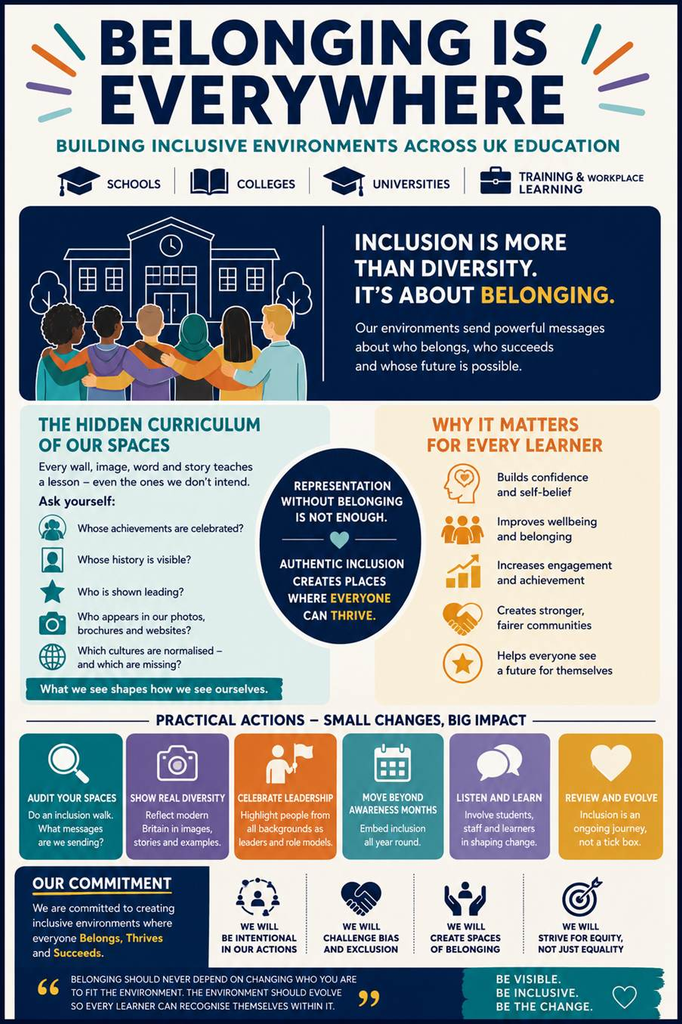
The answer is often communicated long before anyone speaks. It is reflected in the photographs on the walls, the names of buildings, the artwork displayed, the stories taught in classrooms, the promotional brochures, the website imagery, and the people celebrated as role models. Recent research examining environmental racial microaggressions on a university campus highlights something many educators and equality practitioners have understood for years: inclusion is about much more than numbers. Representation without belonging is not enough.
Inclusion is More Than Diversity Statistics
Across the UK, educational institutions have made significant progress in widening participation. Student populations are becoming increasingly diverse, and many organisations proudly promote their Equality, Diversity, and Inclusion commitments.
However, diversity and inclusion are not the same thing. An organisation can have diverse students and staff while still creating environments that subtly communicate:
- “People like you don’t usually succeed here.”
- “Leadership looks different from you.”
- “You are welcome to attend but not necessarily to belong.”
These messages are rarely intentional, yet they can have a profound impact.
The Hidden Curriculum of Physical Spaces
Every educational environment teaches lessons beyond the formal curriculum. Walls, corridors, prospectuses, websites and displays all communicate values. Ask yourself:
- Whose achievements are celebrated?
- Whose history is visible?
- Whose portraits dominate the walls?
- Who appears in marketing materials?
- Who is shown leading rather than simply participating?
- Which cultures are normalised and which are absent?
These visual messages become part of what researchers describe as environmental microaggressions, subtle signals that reinforce exclusion rather than belonging.
Why This Matters in UK Schools
For pupils, identity develops alongside learning. When children rarely encounter people who look like them in displays of excellence, leadership, or achievement, they may unconsciously begin to question whether those futures belong to them. This is not simply about race. Schools should also consider representation across:
- disability
- faith
- gender
- sexual orientation
- socio-economic background
- care experience
- neurodiversity
- ethnicity
- family structures
An inclusive environment benefits every learner because it broadens everyone’s understanding of who can succeed.
Colleges and Universities: Beyond Recruitment
Many colleges and universities invest heavily in recruiting students from underrepresented backgrounds. The greater challenge is ensuring those students genuinely experience belonging once they arrive. Students should not have to spend their education wondering whether they fit in. Inclusive campuses ask important questions:
- Are leadership images representative?
- Do promotional materials reflect authentic diversity rather than tokenism?
- Are students from all backgrounds visible in academic success stories?
- Are cultural celebrations embedded throughout the year rather than confined to awareness months?
- Are physical spaces welcoming to everyone?
Belonging improves wellbeing, engagement, confidence, and educational outcomes.
Training Providers and Workplace Learning
These lessons extend far beyond formal education.
Training providers, apprenticeships, and workplace learning environments also communicate messages through their physical and digital spaces.
Consider:
- training manuals
- websites
- learning platforms
- recruitment campaigns
- photographs
- case studies
- guest speakers
- examples used in teaching
If every leadership example reflects one demographic, learners quickly notice.
If every success story looks the same, aspirations can become limited.
Inclusive learning environments help every participant feel that progression is possible.
Tokenism Isn’t Inclusion
One of the strongest findings from the research is the difference between representation and meaningful inclusion.
Simply adding one image of a Black student, one disabled learner or one visibly diverse member of staff does not automatically create belonging.
People recognise tokenism.
Authentic inclusion means people are shown:
- leading
- innovating
- teaching
- succeeding
- influencing
- participating fully
Representation should reflect reality, not simply satisfy a checklist.
Practical Questions Every Educational Setting Can Ask
Whether you lead a primary school, secondary school, college, university or training organisation, undertake an inclusion walk.
Walk through your environment as if you were visiting for the first time.
Ask:
- What messages do our walls communicate?
- Who is visible?
- Who is invisible?
- Whose stories are celebrated?
- Would every learner see someone with whom they could identify?
- Does our environment reflect modern Britain?
- Are we creating belonging or simply displaying diversity?
Sometimes the smallest environmental changes can have the greatest impact.
Building Genuine Belonging
Creating inclusive educational environments is not about political correctness.
It is about educational excellence.
When learners feel they belong:
- confidence grows
- participation increases
- wellbeing improves
- attainment rises
- engagement strengthens
- communities become more cohesive
Belonging should never depend upon changing who you are to fit the environment.
The environment should evolve so that every learner can recognise themselves within it.
A Final Reflection
Educational institutions shape not only what people know, but how they see themselves.
Every corridor, classroom, website, display board and prospectus tells a story.
The question is:
Does your educational environment simply include diversity, or does it genuinely cultivate belonging?
That is the difference between representation and inclusion—and it is where lasting change begins.