An equality policy should never be a document that is written once, approved by senior leaders and then forgotten.
Policies influence who is recruited, who is promoted, whose concerns are believed, who receives support, who feels safe enough to speak and who quietly leaves because the organisation has failed to respond. They shape decisions, workplace culture and people’s everyday experiences.
When policies are outdated, disconnected or inconsistently applied, they can preserve inequality—even when the organisation’s stated intention is to treat everyone fairly.
That is why policy review is not simply an administrative or compliance exercise. It is an essential part of creating a fair, inclusive, accountable and legally compliant organisation.
Equality law and workplace expectations continue to change
The Equality Act 2010 protects people against unlawful discrimination, harassment and victimisation connected with protected characteristics. Employers must also make reasonable adjustments where disabled workers or applicants would otherwise be placed at a substantial disadvantage. However, legal compliance cannot be achieved by inserting a paragraph about equality into an employee handbook.
Employers must understand how their policies operate in practice and whether apparently neutral requirements create unequal barriers or outcomes.
The legal landscape also continues to develop. Since 26 October 2024, employers have had a positive legal duty to take reasonable steps to prevent sexual harassment of their workers. This is a preventative duty: employers are expected to identify risks and act before harassment occurs, including considering risks involving customers, clients, contractors and other third parties. The Equality and Human Rights Commission can take enforcement action, and a failure to meet the duty may affect compensation awarded by an employment tribunal. EHRC guidance
The Employment Rights Act 2025 is also introducing workplace reforms in stages. Employers should therefore continue to monitor implementation dates and review affected policies rather than waiting for a complaint, grievance or legal claim to expose a gap. Government implementation timeline
Keeping policies current is not just about responding to legislation. Working practices, technology, workforce expectations and our understanding of inequality also evolve. Hybrid working, artificial intelligence in recruitment, Neuroinclusion, digital accessibility, menopause support, changing family structures and increased recognition of intersectionality all require employers to look again at whether their policies remain fair and fit for purpose.
Having a policy does not prove that equality exists
A beautifully written policy cannot protect people if:
- employees do not know that it exists;
- managers do not understand how to apply it;
- people are afraid to use the complaints procedure;
- reasonable adjustment requests are delayed or dismissed;
- similar cases receive different outcomes;
- equality data is collected but never examined;
- managers treat discriminatory behaviour as “banter”;
- the policy has not considered third-party harassment;
- inaccessible processes prevent some people from participating; or
- nobody is accountable for monitoring whether the policy works.
Policies should give people clarity, protection and confidence. They should explain what the organisation expects, what is unacceptable, how concerns will be addressed and who is responsible for taking action.
Most importantly, a policy should help prevent inequality—not merely describe what the organisation will do after harm has occurred.
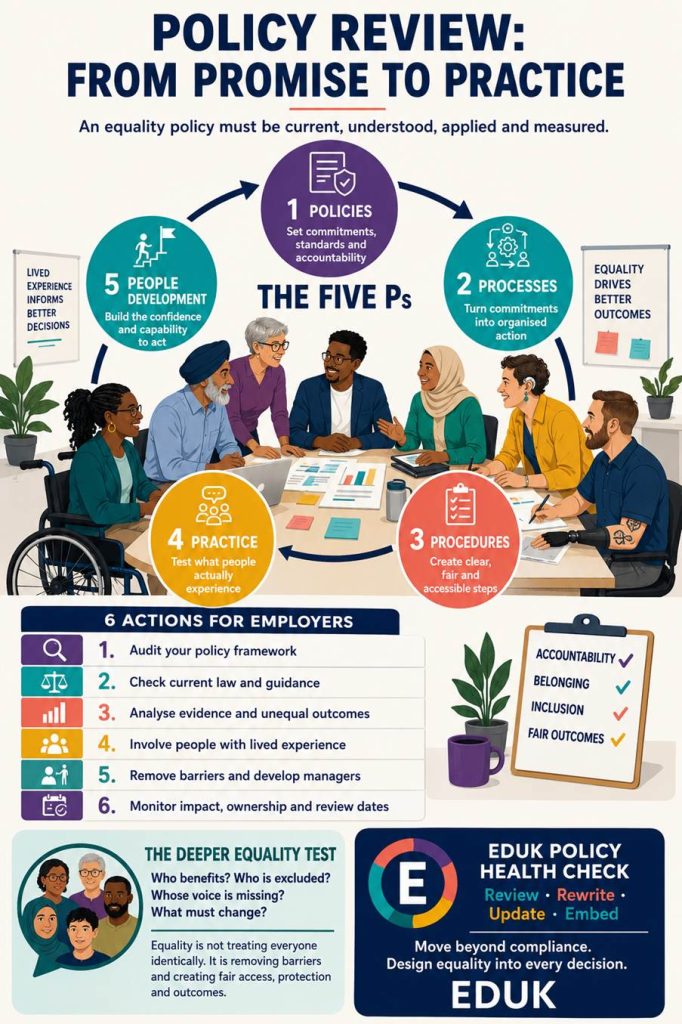
The Five Ps: creating a complete equality framework
At EDUK, we encourage organisations to examine equality through the Five Ps:
1. Policies
Policies establish the organisation’s commitments, principles, standards and responsibilities. They should be legally informed, accessible, inclusive and relevant to the organisation’s workforce and operating environment. They must explain what the organisation is committed to achieving—not simply repeat language from legislation.
A strong policy identifies who is protected, recognises different forms of discrimination and establishes clear accountability. It should also reflect the experiences of people who may face structural disadvantage.
2. Processes
Processes turn policy commitments into organised action.
They determine what happens when someone requests a reasonable adjustment, raises a concern, applies for promotion or reports harassment. A policy may promise fairness, but the supporting process determines whether that promise becomes reality. Employers should map each process and ask where bias, delay, discretion or inaccessibility could create disadvantage.
3. Procedures
Procedures provide clear, practical steps for employees, managers and decision-makers to follow.
They should explain:
- who takes responsibility;
- what action must be taken;
- what evidence is required;
- how confidentiality will be protected;
- what timescales apply;
- how decisions will be communicated;
- what review or appeal routes are available; and
- how equality considerations will be recorded.
Procedures must be sufficiently consistent to support fairness while remaining flexible enough to accommodate individual circumstances and reasonable adjustments.
4. Practice
Practice is what people actually experience.
There can be a significant gap between a written policy and the way it is applied. An organisation may say that it welcomes flexible working applications while managers routinely discourage them. It may promise reasonable adjustments while requiring disabled employees to repeatedly disclose and justify their needs. It may state that harassment will not be tolerated while complaints against senior or high-performing employees are minimised.
Employers must examine the evidence: decisions, outcomes, complaints, employee feedback, exit information, pay data and progression patterns.
If practice does not reflect policy, the organisation has not yet achieved meaningful change.
5. People development
Managers and employees need the knowledge, confidence and skills to put equality into practice.
Publishing a revised policy without supporting learning and development is unlikely to change behaviour. Managers need to understand discrimination, bias, intersectionality, psychological safety, reasonable adjustments and inclusive decision-making. They must also know how to respond when someone reports an issue.
People development should not be limited to a one-off awareness session. It should be connected to leadership expectations, supervision, performance objectives and organisational accountability.
The Five Ps are interdependent:
Policies provide direction. Processes organise action. Procedures create consistency. Practice reveals the reality. People development makes sustainable change possible.
Policies employers should review or have in place
The following areas should be addressed within an organisation’s policy framework. They do not necessarily require 24 separate documents. Some may be combined, depending on the organisation’s size, structure, sector and risks. However, every area should be considered clearly rather than assumed to be covered.
- Equality, Diversity and Inclusion
- Dignity at Work, Bullying and Harassment
- Sexual Harassment Prevention
- Recruitment, Selection and Promotion
- Reasonable Adjustments and Disability Inclusion
- Flexible Working
- Maternity, Paternity, Adoption and Parental Leave
- Carers and Dependants
- Grievance and Complaints
- Disciplinary and Capability
- Whistleblowing and Speaking Up
- Pay, Reward and Equal Pay
- Performance Management and Progression
- Trans and Non-binary Inclusion
- Religion or Belief
- Menopause and Reproductive Health
- Domestic Abuse Support
- Sickness Absence and Health at Work
- Hybrid and Remote Working
- Data Collection and Equality Monitoring
- Equality Impact Assessment
- Procurement and Supplier Equality
- Digital Accessibility and Inclusive Communication
- Safeguarding, where relevant
Organisations must distinguish between legal requirements and recommended good practice. Not every employer is legally required to maintain every item as a separate policy, and additional duties may apply according to the sector, size and status of the organisation.
For example, public authorities and organisations exercising public functions may have obligations under the Public Sector Equality Duty that do not apply to every private employer. Sector regulators, commissioners, funders and contractual arrangements may also establish additional requirements.
Applying the deeper equality test
A policy review should go beyond checking dates, replacing outdated terminology or adding references to protected characteristics.
Employers should ask:
- Who benefits from this policy?
- Who may be disadvantaged, excluded or less able to access it?
- Whose lived experience informed its development?
- Have employees and staff networks been meaningfully involved?
- Are managers applying the policy consistently?
- Where does managerial discretion enter the process?
- Could that discretion introduce conscious or unconscious bias?
- Are reasonable adjustments timely, individualised and effective?
- Is information available in accessible formats?
- Does the evidence reveal unequal decisions or outcomes?
- Are complaints treated seriously regardless of who is involved?
- Is accountability clearly assigned?
- Are employees protected against victimisation when they speak up?
- Does the policy consider intersectionality and compound disadvantage?
- Does it prevent inequality rather than merely responding after harm occurs?
The question is not simply, “Do we treat everyone the same?”
Treating everyone identically can reproduce inequality when people begin from different positions or experience different barriers. The more meaningful question is:
Does this policy give people equitable access to opportunity, protection, support and fair outcomes?
Warning signs that a policy needs urgent review
An organisation should not wait for its scheduled review date if:
- legislation or official guidance has changed;
- a tribunal decision has exposed an area of risk;
- complaints or grievances show a recurring pattern;
- particular groups experience poorer recruitment, pay or progression outcomes;
- adjustment requests are taking too long;
- employees do not trust reporting arrangements;
- managers interpret the policy differently;
- the organisation has restructured or introduced new technology;
- working arrangements have changed;
- employee feedback identifies barriers or exclusion;
- an incident reveals that responsibilities are unclear; or
- the document no longer reflects the organisation’s workforce or services.
A regular review cycle is important, but equality risks should also be monitored continuously.
Actions employers should take
Audit the full policy framework
Create a policy register recording each document’s owner, approval date, next review date, related procedures and relevant legal or regulatory requirements.
Prioritise according to risk and impact
Begin with policies affecting safety, dignity, access to work, pay, progression, disciplinary decisions and the ability to raise concerns.
Examine workforce evidence
Review recruitment, retention, absence, pay, promotion, grievance, disciplinary, adjustment and exit data. Where numbers are small, protect confidentiality and avoid drawing unreliable conclusions.
Involve people with lived experience
Consultation must be meaningful, safe and accessible. Avoid expecting minoritised employees to provide unpaid emotional labour or represent everyone who shares a characteristic.
Undertake an equality impact assessment
Consider who may experience positive or negative effects, identify unintended consequences and record how barriers will be removed or mitigated.
Review the supporting processes and procedures
Do not change the policy while leaving a discriminatory or inaccessible process untouched.
Provide accessible communication
Use clear language and accessible formats. Explain the changes, what they mean in practice and where people can obtain confidential support.
Develop managers and decision-makers
Provide role-specific learning, practical scenarios and guidance. Managers must understand both the policy and the reasoning behind it.
Monitor implementation
Set measures, identify responsible leaders, evaluate outcomes and report progress. A policy review is not complete when the document is published.
Why independent support can make a difference
Internal teams understand their organisations, but this familiarity can also make embedded assumptions difficult to recognise.
Independent equality expertise can provide constructive challenge, identify legal and practical gaps and bring a deeper understanding of how policies affect people with different identities and experiences.
EDUK can support organisations to:
- audit existing policies, processes and procedures;
- identify outdated, inconsistent or exclusionary provisions;
- review equality risks and organisational evidence;
- undertake or strengthen equality impact assessments;
- involve employees and lived-experience voices appropriately;
- rewrite policies using clear and inclusive language;
- design practical procedures and decision-making tools;
- develop implementation and communication plans;
- train managers and policy owners;
- establish monitoring, accountability and review arrangements; and
- align the Five Ps across the organisation.
Our approach is anchored in deep equality. We do not simply add inclusive language to an existing document. We examine power, access, barriers, participation, protection and outcomes.
Move from written commitments to fair outcomes
An outdated policy creates legal, cultural and reputational risk. More importantly, it can leave people without the protection, opportunity or support they need.
A current policy is only the beginning. Employers must ensure that their processes are fair, their procedures are accessible, their practice reflects their commitments and their people have the capability to act.
That is the purpose of the Five Ps:
Policies. Processes. Procedures. Practice. People development.
Together, they turn equality from a statement of intent into an everyday organisational standard.
Is it time for an EDUK Policy Health Check?
EDUK can review, rewrite and update your equality-related policies, processes and procedures—helping your organisation meet its responsibilities, prevent inequality and build fairer outcomes into every decision.
Do not wait for a grievance, complaint or legal challenge to reveal what your policies have failed to prevent.
Contact EDUK to begin your Equality Policy Health Check.