
The central message: A safeguarding policy is not inclusive because it says everyone will be treated equally. It is inclusive when its reporting routes, risk assessments, investigations, communications, adjustments, and remedies work for people whose lives do not fit a single-category template.
Foreword: why these matter
Safeguarding is often discussed as though it belongs only to schools, care settings or organisations collaborating with people formally described as ‘vulnerable.’ That is too narrow. Every employer, community interest company (CIC), charity, and voluntary organisation has a responsibility to reduce the risk of harm to the people who work for it, volunteer with it, receive its services or encounter it through its activities.
For employers, poor safeguarding damages people, workplace trust, retention, wellbeing, and organisational credibility. For staff and volunteers, it determines whether they can raise a concern without being dismissed, stereotyped, isolated, or punished. For trustees and CIC directors, safeguarding is a governance issue: a policy that is copied, filed away, and disconnected from practice cannot demonstrate effective oversight.
This blog is important because many policies promise fairness while the process underneath them assumes a ‘standard’ person: confident, fluent in organisational language, able to respond quickly, comfortable with meetings, believed when they speak, and unaffected by racism, sexism, ableism, homophobia, transphobia, or other bias. People who do not fit that assumption are often asked to carry the heaviest burden of proving harm while receiving the least support.
Safeguarding is evaluated at the point of challenge. The true measure of a policy is not how reassuring it sounds when nothing is wrong. It is what happens when someone reports harm, communicates differently, challenges a decision, becomes distressed, or asks the organisation to examine its own conduct.
The problem with ‘one size fits all’
Too many organisations write policies by finding another organisation’s document, changing the name, and adopting the text. Looking at examples can be useful, but copying is not policy development. It can import assumptions, gaps, legal errors, and procedures that do not match the organisation’s people, services, risks, resources, or decision-making structure. A generic policy may mention sex, race, disability, or sexual orientation in separate lines, yet fail to consider how these identities interact. A Black neurodivergent lesbian, for example, does not experience each aspect of her identity one at a time. She may face a combined pattern of disbelief, stereotyping, communication barriers, and isolation that cannot be understood by asking only whether a man and a woman were treated differently.
Intersectionality is not an optional diversity slogan. It is a practical way of asking whether overlapping identity, power and circumstance change the risk of harm, the likelihood of being believed, the ability to report, the response received and the remedy required.
Equality is not sameness
Treating everybody identically can reproduce inequality. A person who needs information in writing, one question at a time, additional processing time, an advocate, a quiet meeting space or a choice of reporting method is not receiving an ‘advantage.’
They are being given a fair opportunity to participate. Good policy therefore combines consistent principles with responsive practice. The standard should remain firm – safety, fairness, evidence, accountability, and dignity – while the method adapts to the person and the situation.
Lived experience
The case study supplied for that prompted me to write this blog describe Sandra a volunteer in a charity, feeling overwhelmed, excluded and left to manage serious concerns largely by herself.
She reported that leaders met about her, suspended her from volunteering, did not give her a sufficiently clear account of the concerns or process, declined access to records on the basis that they were private, and later characterised her as ‘hostile’ and ‘difficult.’
She felt that her neurodivergence, communication style and processing needs were not carefully considered.
These are reported experiences, not findings of fact. Their value for policy learning lies in the questions they raise:
- Can a person understand the allegation, concern or risk being considered and respond meaningfully?
- Is the person who raised a concern protected from actual or perceived retaliation?
- Are distress, persistence, directness or repetition being interpreted through ableist, gendered or racialised stereotypes?
- Are behaviours described specifically and neutrally, or replaced by character labels such as ‘difficult’ or ‘aggressive’?
- Are reasonable adjustments discussed before decisions are made, rather than offered after harm has occurred?
- Is there a named contact, a timetable, written reasons, and an independent review route?
- Does the organisation support the person who reported harm, or quietly make them responsible for navigating the whole system alone?
A crucial safeguard: Separate safeguarding risk assessment from judgements about communication style. A person can be distressed, direct or persistent and still be raising a valid concern. Decision-makers must examine evidence, context, disability-related barriers, and power – not whether the person made them feel comfortable.
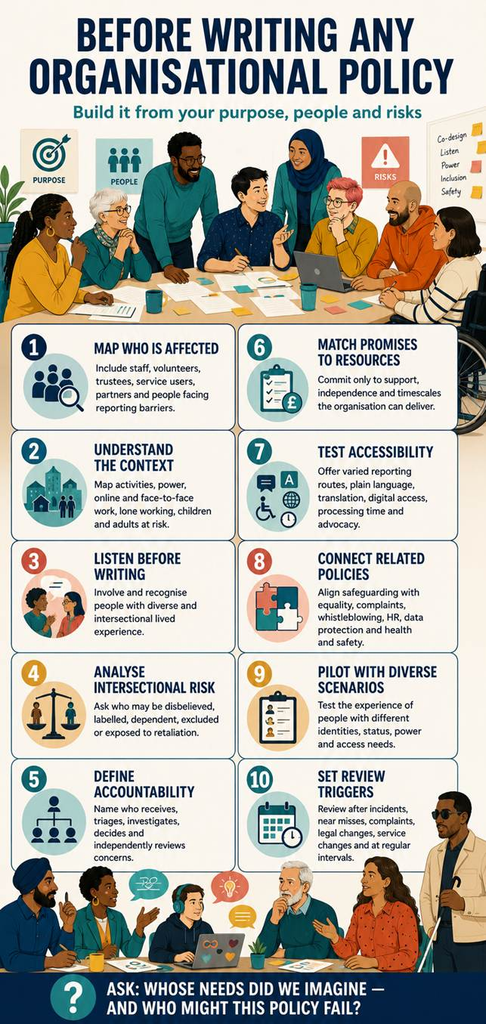
What a strong safeguarding policy must contain
1. Purpose, scope, and principles
- A clear commitment to preventing harm, responding promptly, and treating safety, dignity, choice, and fairness as linked duties.
- Who and what the policy covers, including staff, volunteers, leaders, beneficiaries, service users, partners, contractors, events, travel, digital spaces, and off-site activity.
- A statement that safeguarding applies to everyone who comes into contact with the organisation, not only groups traditionally labelled as vulnerable.
2. Definitions and forms of harm
- Plain-language definitions of safeguarding, abuse, neglect, harassment, exploitation, retaliation, bullying and a conflict of interest.
- Recognition of physical, sexual, psychological, discriminatory, financial, organisational, domestic, and online abuse, neglect, and self-neglect where relevant.
- Examples that reflect diverse identities and circumstances rather than presenting one stereotypical victim or perpetrator.
3. Equality, intersectionality, and reasonable adjustments
- An explicit requirement to consider the combined effect of disability, race, sex, gender reassignment, sexual orientation, age, religion or belief, pregnancy and maternity, marriage, and civil partnership where relevant, as well as poverty, language, caring responsibilities, and immigration status.
- It is a duty to ask what communication, access, cultural or advocacy support the person needs, without imposing a generic package.
- A requirement to distinguish evidence of risk or misconduct from stereotypes about tone, eye contact, emotional expression, credibility, culture, or neurodivergent communication.
4. Prevention and safer working
- Role design, safer recruitment, proportionate checks, references, induction, codes of conduct, supervision, lone-working controls, and boundaries for online contact.
- Clear expectations for leaders as well as frontline staff and volunteers; seniority must never reduce scrutiny.
- Information for staff, volunteers, and service users on expected behaviour and how to report concerns.
5. Accessible reporting routes
- Named internal routes plus an alternative when the concern involves the usual contact, a senior leader, trustee, or director.
- Options to report verbally, in writing, online, with an advocate, anonymously where possible, or through a third party.
- Emergency contacts and clear thresholds for the police, local authority safeguarding services, regulators, funders, and other external bodies.
- A statement that a reporter does not need to prove the case before raising a concern.
6. Immediate response and risk triage
- How to respond to immediate danger, urgent medical need, preservation of evidence and the person’s immediate safety and wellbeing.
- A documented, proportionate risk assessment that considers the wishes of the person affected, the safety of others, power imbalances, potential retaliation, and any need for interim measures.
- Interim action that is neutral, time-limited, reviewed and not presented as a finding before investigation.
7. Fair, impartial, and accessible investigation
- The case to answer, evidence to be considered, roles, authority, conflicts, standard of decision-making and indicative timescales.
- A meaningful opportunity for relevant people to respond, with adjustments, support, breaks, and additional processing time.
- Neutral fact-finding that avoids character judgements and tests alternative explanations, including bias and disability-related communication.
- Independent oversight where a senior person, safeguarding lead or close colleague is implicated.
8. Communication, outcomes, and review
- A named contact, acknowledgement, realistic update frequency, and an explanation when deadlines change.
- A written outcome that gives as much information as lawfully possible: decision, reasons, action, responsible owner, timescale, and review route.
- A correction mechanism where records are inaccurate, and a way to attach the person’s challenge where disagreement remains.
- An appeal, review or reconsideration route that is sufficiently independent.
9. Confidentiality, information sharing, and records
- Confidentiality on a need-to-know basis, without promising secrecy that cannot be maintained.
- Lawful, proportionate information sharing; data minimisation; secure records; retention periods; access controls; and clear handling of subject access requests.
- Separation of fact, allegation, professional judgement, and decision in case notes.
10. Protection, support, and organisational learning
- Protection from victimisation, retaliation, exclusion, or disadvantage for raising a concern in good faith.
- Support for the person affected, the reporter, witnesses, and the person subject to an allegation, without creating false equivalence or compromising safety.
- Post-case review, equality analysis, trend monitoring, trustee/director oversight, action tracking, and transparent learning.
Policy wording: make every promise actionable
Policies often fail because they use reassuring but passive language: concerns will be taken seriously, support may be offered,’ or ‘diversity will be considered.’ These phrases do not tell anyone what must happen. Every important commitment should have an action, owner, timescale, record, and review route.
| Weak or generic wording | Stronger, inclusive wording | Evidence that it happened |
| We treat everyone equally. | We apply consistent safeguarding standards and adapt communication, access, and support to remove individual disadvantage. | Adjustment record; communication plan; reasons for any refusal. |
| Concerns will be taken seriously. | The safeguarding lead will acknowledge a concern within two working days, assess immediate risk, and confirm the next step and named contact. | Acknowledgement; risk assessment; action log. |
| Confidentiality will be maintained. | Information will be shared only where necessary and lawful. We will explain, as far as possible, who needs information and why. | Information-sharing decision and rationale. |
| Inappropriate behaviour will be investigated. | An investigator without a material conflict will establish the allegations, evidence, adjustments, response opportunity, findings, and reasons within an agreed timetable. | Terms of reference; evidence log; adjustment record; reasoned outcome. |
| Diversity will be considered. | Risk assessment and decision-making will consider whether overlapping identity, power, disability, culture, or communication barriers affect exposure to harm, credibility, access, or impact. | Intersectional prompts completed; bias check; equality monitoring. |
Mandatory staff and volunteer training
A policy cannot compensate for untrained decision-makers. Staff, volunteers, managers, safeguarding leads, investigators, trustees, and CIC directors need appropriate mandatory training linked to their roles/responsibilities. Lived experience should inform the programme, but nobody should be required to disclose trauma or educate colleagues without choice, support, and recognition.
Training must go beyond definitions and reporting flowcharts. It should include:
- core safeguarding duties, types and indicators of harm, immediate danger, and external referral routes.
- the organisation’s own reporting, recording, escalation, and whistleblowing procedures.
- equality law, reasonable adjustments, and accessible communication.
- intersectionality and the ways racism, sexism, ableism, homophobia, biphobia, transphobia, ageism, and class bias can combine.
- unconscious and conscious bias in credibility assessments, language, and risk decisions.
- trauma-informed, culturally responsive and neuroinclusive communication.
- how to describe behaviour neutrally and specifically rather than using labels such as ‘difficult,’ aggressive, over-emotional’ or ‘non-compliant.’
- fair investigations, conflicts of interest, evidence managing, confidentiality and data protection.
- retaliation, victimisation, and the particular risks faced by volunteers, junior staff, and people dependent on services.
- scenario practice involving multiple protected characteristics, followed by reflective challenge and feedback.
- responsibilities of senior leaders and boards, including how to respond when the allegation concerns someone powerful.
- assessment of learning, refresher training, supervision, and consequences where required practice is not followed.
Training principle: Representation matters, but identity alone does not guarantee fair decisions. Diverse panels, lived-experience input, skilled facilitation, reflective supervision, documented bias checks and independent challenge must work together.
Minimum training framework
- Induction before unsupervised activity: policy, code of conduct, reporting routes, emergency action, and boundaries.
- Annual core refresher for all staff and volunteers, supplemented by immediate updates after material policy or legal changes.
- Enhanced training for safeguarding leads, managers, HR, investigators, trustees and directors, including equality analysis, trauma, neurodivergence, information governance and fair process.
- Scenario-based competence checks rather than attendance-only certificates.
- Supervision and case review to identify drift between policy and practice.
- A central training record showing role, module, date, outcome, refresher due date, and action where training is overdue.
A practical policy audit checklist
Boards, trustees, directors, and senior managers can use these questions to evaluate whether their policy is real, inclusive, and operational.
- Was the policy written for our organisation, or copied with names changed?
- Did people with diverse and intersectional lived experience shape it?
- Can everyone identify at least two safe reporting routes, including one outside the usual management line?
- Can a person report in different formats and with an advocate or supporter?
- Does the process proactively ask about adjustments and communication needs?
- Do risk and investigation templates prompt decision-makers to consider power, bias, and intersectional impact?
- Are behaviour concerns described with specific examples, context and impact rather than labels?
- Is the person raising the concern protected from retaliation and kept informed?
- Are interim measures neutral, proportionate, reviewed and time-limited?
- Are conflicts checked and independent oversight available when leaders are implicated?
- Are decisions explained in writing with reasons, actions, owners, dates, and a review route?
- Are records accessible, accurate, secure, and separated into fact, allegation, judgement, and outcome?
- Is mandatory training role-specific, assessed and monitored?
- Does the board receive anonymised trend, equality, and action data rather than only incident counts?
- Do we learn after each case and show what changed?
What good safeguarding looks like in practice
Good safeguarding is not a perfect policy. It is a trustworthy system in which people know how to speak, are supported to participate, are not reduced to stereotypes, and receive decisions that can be understood and challenged. It recognises that the same procedure can affect people differently and that power is part of risk.
For someone in Sophia’s position, which would mean a written explanation of the concern and process; a meaningful chance to respond; an advocate if wanted; communication and processing adjustments; neutral descriptions of behaviour; a consistent contact; protection from retaliation; timely updates; an impartial decision; written reasons; and a review route. It would also mean that her experience leads to organisational learning, not merely an instruction that she must cope better next time.
Final challenge to leaders: Do not ask only, ‘Do we have a safeguarding policy?’ Ask, ‘Whose needs did we imagine when we wrote it, who is least well served by it, and what evidence shows that our actions match our words?’
Selected official guidance (not legal advice)
- Charity Commission: Safeguarding and protecting people for charities and trustees
- Charity Commission: Safeguarding charities and trustees
- DCMS: Guidance on handling safeguarding allegations in a charity
- Acas: Adjustments for neurodiversity
- Acas: Neurodiversity – performance, conduct and capability
- Equality and Human Rights Commission: Protected characteristics
- Information Commissioner’s Office: A guide to subject access